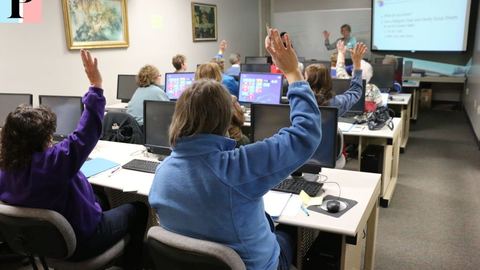
Key steps to becoming a future trainer

Wouldn't the greatest characteristic of humans be to seek to be able to transmit constantly? Throughout history, experienced elders have always taken on the role of teachers to the younger generations: it is a necessary handover to perpetuate a way of life, a culture and above all multiple knowledge. We thus learn to transmit to others, while giving them the capacity to one day be able to transmit in turn.
But whether you have great situational intelligence or good adaptation to your interlocutor, becoming a trainer cannot really be improvised. Before taking the plunge, you should always keep certain rules in mind.
Rules which constitute obligatory points of passage in terms of animation, pedagogy, or even quality of listening. Take training to become a trainer in turn includes precise steps that it is essential to follow in order.
What are the first steps to follow?
Let's say you've been passionate about plants since you were a child. You do not have a diploma or follow any course related to botany. But you have spent many years self-taught to develop a rich culture. Through documentaries or books, you have absorbed a certain amount of knowledge on the subject. Knowledge that allows you to talk about botany and its techniques in the most comfortable way possible. Certain areas remain very supervised and regulated at this level. That said, if you suddenly feel the urge to pass on your knowledge, you are not obliged to obtain a diploma. You are also not always forced to have a professional background related to what you want to approach. However, this does not mean that you can arrive with your hands in your pockets.To enlighten you, here is what we can read in the labor code:
Article L6352-1 (Modified by LAW n°2009-1437 of November 24, 2009 - art. 49) "It is not necessary to justify a particular professional qualification to become a trainer or open a continuing professional training organization. However, any person who offers continuing professional training services must justify the qualifications and qualities of the teaching and management staff they employ, and the relationship between these qualifications and qualities and the services provided in the field of professional training." What you need to understand here is that you can aspire to become a trainer in the long term provided you have followed specific training. Through an organization specialized in training preparation, you will learn all the good techniques and behaviors to adopt with your interlocutor(s). Read also: Why take a Communication Process training course?The main concepts for a trainer
Working on animation and its fundamentals
To ensure that you can transmit brilliantly, it is first necessary to understand the role played by the trainer: what are their functions? What attitudes should they adopt towards their interlocutors? We often distinguish 3 main functions related to the trainer:
- Production, which includes taking into account all the objectives to be achieved for those who are trained and all the solutions to achieve them. The objectives can take multiple forms but must imperatively be stated and understood from the beginning of a teaching session.
- Facilitation, the aim of which is to clarify the work of a person or group on the objective in question. This involves articulating a precise plan, which includes the essential steps in an orderly manner. The exercises resulting from this plan must be made intelligible and understandable by everyone.
- Regulation, for its part, seeks to control the cohesion of the working group. It takes into account the psychological aspect of the interlocutors and their interactions. Regulating group cohesion means being able to avoid possible tensions between those we train by ensuring that we put them on an equal footing.