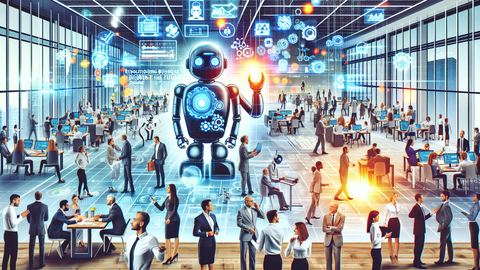
How are UiPath and AI revolutionizing the future of automation?

|
IN BRIEF
|
Business process automation is changing thanks to the emergence of advanced technologies like UiPath and artificial intelligence (AI). Together, these tools are not only redefining how businesses operate, but also transforming human interactions with technology. UiPath, a leader in robotic process automation (RPA), uses AI solutions to improve efficiency, reduce errors and free up time for higher value tasks. This marriage between automation and AI promises to be an essential lever for companies wishing to optimize their productivity and innovate in a constantly evolving economic context. Analyzing this impact highlights an ongoing revolution, where tradition and innovation intertwine to shape the future of business operations.
With the advent of artificial intelligence (AI) and advanced automation technologies like UiPath, the industrial landscape is transforming. This article explores how these innovations are redefining automation processes, providing a clear view of the current and future impact of these technologies on various sectors.
Automation Basics with UiPath
UiPath is a robotic process automation (RPA) platform that enables organizations to automate repetitive tasks. The main goal is to free employees from time-consuming work and allow them to focus on higher value-added tasks. Using software robots, UiPath can automate complex manual processes increasing efficiency and reducing human errors.
Integrating AI into UiPath
UiPath integrates AI capabilities to enhance the capabilities of its automation platform. AI allows UiPath to handle more complex tasks that typically require some degree of contextual understanding, such as text recognition (OCR), image analysis, and natural language understanding (NLP). This significantly expands the scope of automation by allowing robots to interact more intuitively with systems and users.
Optical Character Recognition (OCR)
Optical Character Recognition (OCR) is a key AI technology integrated into UiPath. It allows robots to read and extract information from scanned documents, which is particularly useful for automating the processing of forms, invoices and other types of documents. OCR reduces manual entry errors and increases the speed of data processing.
Image analysis and artificial vision
Using artificial vision, UiPath can analyze and interpret images with great precision. This capability is crucial for applications such as identity verification, quality inspection in production lines, and security monitoring. Robots can identify anomalies or deviations from standards, making control processes more reliable.
Natural Language Understanding (NLP)
Natural language understanding (NLP) allows UiPath bots to handle tasks requiring linguistic interaction, such as customer service, email management, and data entry. By using NLP algorithms, bots become able to understand and respond to user queries in a more human way, thereby improving the quality of automated interactions.
| Appearance | UiPath and AI |
| AI Integration | UiPath integrates AI algorithms to improve automated decision-making. |
| Efficiency | Intelligent automation to reduce human errors and increase productivity. |
| Adaptability | Ability of machine learning solutions to adjust to variations in business processes. |
| Accessibility | UiPath makes automation accessible through simplified visual interfaces. |
| Collaboration | Promotes better collaboration between humans and machines. |
| Scalability | Facilitates the expansion of automated operations as businesses grow. |
| Data analysis | Uses data mining techniques to extract actionable insights from operational data. |
- Optimization of business processes
- UiPath uses AI to analyze and improve workflow efficiency.
- Intelligent automation
- Integrating AI allows robots to learn and adapt.
- Improved customer experience
- AI-powered chatbots provide responsive 24/7 customer service.
- Predictive analytics
- Ability to anticipate needs and adjust operations in real time.
- Reduction of human errors
- Increased accuracy through automation of repetitive tasks.
- Organizational agility
- Facilitates rapid adaptation to market and technological changes.
- Improved collaboration
- Human teams can focus on higher value-added tasks.
- Data Accessibility
- AI enables more efficient data collection and use.
- Cost savings
- Reduced operational costs through automated processes.
- Continuous innovation
- Constant development of new features and improvements using AI.
Reduced costs and increased productivity
One of the main reasons why businesses adopt UiPath and AI is the significant reduction in operational costs. Automation reduces the need for labor for repetitive tasks, reducing overhead costs while increasing productivity. Additionally, UiPath robots can work 24/7 without interruption, ensuring operational continuity and increased efficiency.
Improved customer experience
Automation and AI technologies significantly improve the customer experience. Automated customer service processes help respond to customer inquiries more quickly and accurately. For example, AI-powered chatbots can provide instant support and redirect customers to the appropriate resources, thereby reducing wait times and improving customer satisfaction.
Use cases of UiPath and AI in different industries
Banking and financial sector
In banking and finance, UiPath and AI are used to automate processes like customer background checks (KYC), fraud detection, and transaction processing. Automating these tasks reduces processing times and increases accuracy, while ensuring compliance with strict industry regulations.
Health sector
In healthcare, UiPath and AI help automate patient record management, appointment scheduling, and automate clinical workflows. This allows healthcare professionals to focus more on patient care while minimizing administrative tasks.
Manufacturing sector
In the manufacturing sector, automation plays a crucial role in improving the efficiency of production lines. UiPath robots can monitor machines, perform quality checks, and optimize manufacturing processes in real time. AI also helps predict machine failures, reducing costly downtime.
Human resources sector
Human resources departments use UiPath to automate recruiting, payroll, and compliance processes. AI helps sort and analyze applications, schedule interviews, and ensure that all HR procedures are followed in accordance with current regulations. This frees up time for human resource managers, so they can focus on strategic activities.
The challenges and considerations of adopting UiPath and AI
While the benefits of automation and AI are numerous, there are also challenges to overcome. Integrating these technologies requires careful planning and effective change management. Organizations must also invest in training their staff so that they can work effectively with new technologies.
Change management
Implementing automation and AI often leads to significant changes in work processes. Businesses must manage these transformations carefully to minimize disruption. This includes communicating with employees, training and adjusting organizational structures to accommodate new automated workflows.
Data security
Data security is a crucial consideration when adopting UiPath and AI. Automated bots handle large amounts of sensitive data. Therefore, businesses must implement robust security protocols to protect this information from cyber threats.
Return on investment (ROI)
Finally, businesses must evaluate the return on investment (ROI) of automation. Although the initial costs may be high, the long-term benefits in terms of reduced costs and improved productivity often justify these expenses. Rigorous financial analysis helps determine the viability and effectiveness of automation projects.
The future of automation with UiPath and AI
The future of automation looks bright with continued developments in AI and RPA technologies. UiPath continues to innovate, delivering new features and enhancements to meet the changing needs of industries.
Hyperintelligent Automation
Hyperintelligent automation is an emerging trend that combines RPA, AI, and machine learning to create even more intelligent and autonomous processes. This approach aims to automate not only individual tasks, but also entire business processes, with minimal human intervention.
Human-machine collaboration
Human-machine collaboration is another key future dimension. Rather than completely replacing humans, robots and AI will work alongside them to enhance human capabilities. This synergy will allow complex tasks and problem-solving by combining human creativity with the precision and speed of machines.
Autonomous Systems
Autonomous systems represent another promising direction for the future. Fully autonomous robots that can make decisions and execute tasks without human intervention are in development. These systems will be able to adapt to dynamic environments and handle unforeseen situations efficiently.
In short, UiPath and AI are redefining the automation landscape. With their advanced capabilities, they pave the way for more efficient processes, significant cost reductions, and improved customer experiences. By adopting these technologies, businesses are better prepared for the future, ready to meet the challenges and seize the opportunities of digital transformation.
UiPath is a robotic process automation (RPA) platform that enables businesses to automate repetitive, rules-based tasks.
AI is integrated into UiPath through technologies such as natural language processing (NLP) and machine learning, enabling robots to understand and act on unstructured data.
Benefits include reduced costs, increased productivity, improved accuracy, and freeing up employees for higher-value tasks.
Industries such as finance, healthcare, logistics, and customer service are particularly benefiting from automation with UiPath.
Although technical skills can help, UiPath offers a user-friendly interface that allows non-technical users to implement automation solutions.
Rather than replacing jobs, automation aims to make employees' jobs easier, allowing them to focus on more strategic and creative tasks.
Challenges include managing organizational change, the need to train employees, and the complexity of integrating existing systems.
The future of automation with UiPath will involve solutions that are smarter, more integrated, and more capable of handling complex scenarios thanks to advances in AI.